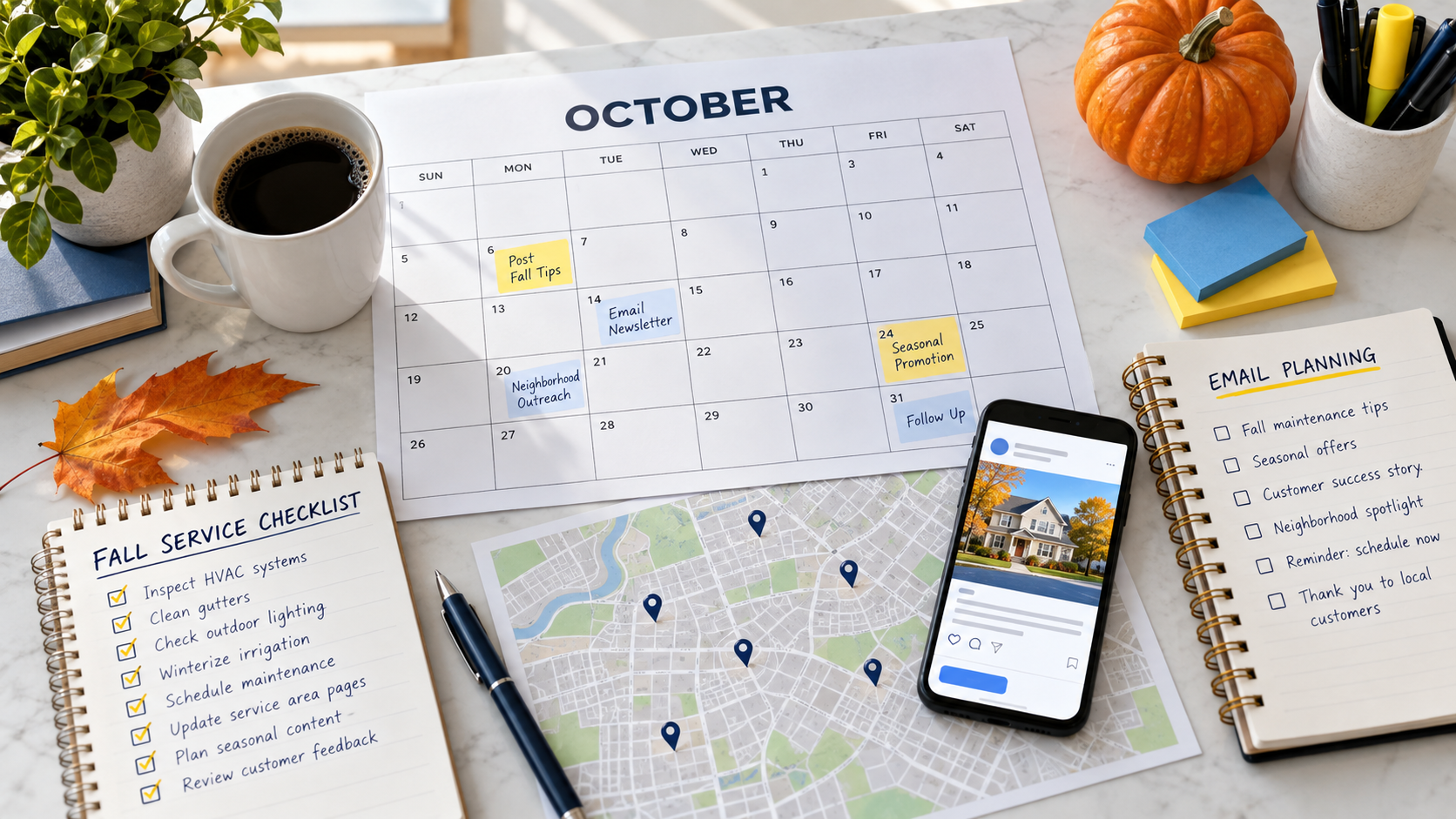
October creates a crowded local marketing calendar. Homeowners are preparing for colder weather, finishing exterior projects, reviewing household budgets, planning school and community activities, and seeing early holiday promotions at the same time.
A local service business is not competing only with similar providers. It is competing with every urgent household decision asking for attention. The practical response is not to publish more promotions. It is to choose one clear seasonal problem, one useful next step, and one supporting campaign idea that makes the offer easier to notice and remember.
Quick answer: What are effective local marketing ideas for October?
Effective October local marketing ideas include a seasonal service checklist, a time-bounded maintenance offer, a neighborhood education campaign, a partner promotion, a customer story, and a relevant giveaway that supports the main service message. Give each idea a specific job: create awareness, capture permission, generate an appointment, reactivate past customers, or build an audience for later follow-up.
Why October attention is fragmented
October sits between summer project season and the year-end holiday rush. Exact service priorities vary by region, but several categories commonly overlap: heating readiness, weatherproofing, roofing and gutter work, indoor-air concerns, landscaping closeout, safety checks, and budget-sensitive planning for larger projects.
Consumers also see school fundraisers, fall festivals, Halloween promotions, sports sponsorships, retail events, and early holiday offers. A generic discount can disappear in that noise, while a promotion with too many promises can make the next action unclear.
The six promotion types competing for attention
- Seasonal readiness offers. Connect the offer to a near-term household need, such as a tune-up, inspection, cleaning, or weather-preparation service. Make the scope, timing, service area, and next step concrete.
- Educational checklists. Help homeowners recognize a problem before requesting service. A concise checklist can work as a blog post, downloadable guide, email, or Business Profile update.
- Limited-time discounts. State what is included, who qualifies, and when the work must be scheduled. Avoid stacked deadlines or exclusions that make the offer hard to trust.
- Community and partner campaigns. Local events, school partnerships, and complementary businesses can add trust and distribution. Use one destination page and distinguish partner traffic from other sources.
- Customer proof. A seasonal case study, project walkthrough, or before-and-after story helps people evaluate the service. Use accurate, permissioned examples and avoid guarantees.
- Giveaways and prize promotions. A giveaway can earn attention and permission when the prize, audience, eligibility, and follow-up plan align. Use it as an amplifier for the service theme, not as an unrelated contest.
Where a giveaway fits in an October campaign
A useful giveaway has a supporting role. An HVAC company might lead with a fall comfort checklist and maintenance offer, then use a home-comfort package to expand reach and capture people who are interested but not ready to book. A roofing company might pair a seasonal inspection guide with a locally relevant home-protection prize.
The prize should attract a plausible future customer, the landing page should separate sweepstakes entry from the service offer, and the form should collect only information that has a defined operational use. Participation should not be treated as blanket consent for unrelated marketing.
The FTC notes that sweepstakes-type promotions requiring a purchase are illegal in the United States and that state requirements may vary. Google Business Profile guidance says promotions and giveaways should link clearly to terms and provide guidelines and qualifications. Confirm the applicable legal and platform requirements before launch.
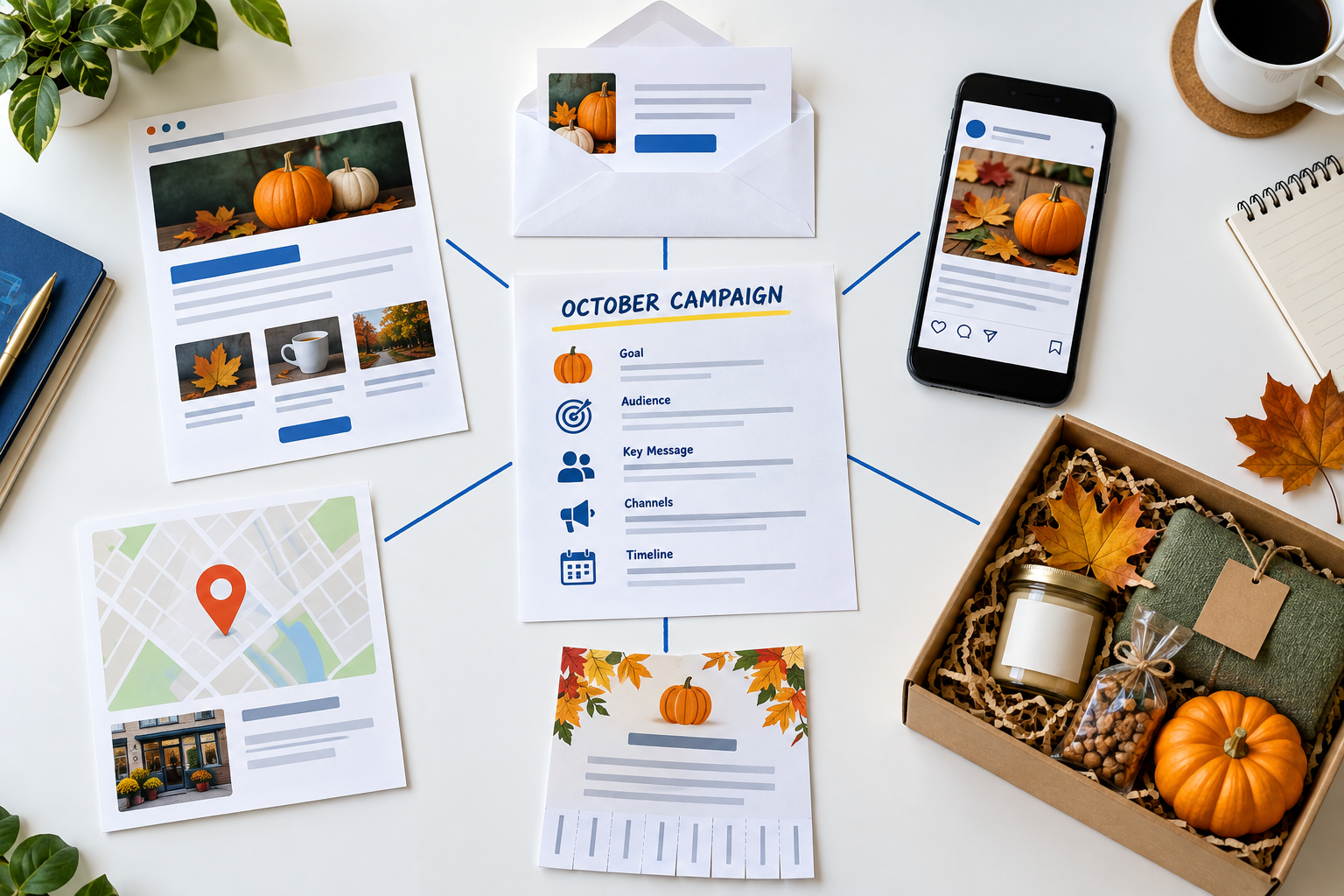
Use one message architecture across every channel
The campaign should feel like one coordinated idea even when it appears in different places. Use four elements:
- Seasonal problem: name the homeowner concern in plain language.
- Useful promise: explain what the checklist, service, or consultation helps the customer do.
- Time cue: state the relevant scheduling window without manufacturing urgency.
- Next action: direct people to one landing page, booking path, or entry experience.
Google Business Profile supports update, offer, and event posts with photos, videos, dates, and action links. Use the profile to reinforce a campaign that already has a clear destination, not to create a disconnected duplicate with different dates or terms.
A practical October channel plan
- Website: publish the campaign page and one supporting article that answers the main question.
- Email: segment past customers, prospects, and partners when the message or next action differs. Use accurate subject lines, a valid mailing address, and a working opt-out process.
- Business Profile: publish the appropriate update, offer, or event format with complete dates and a link to the canonical campaign page.
- Social: adapt the opening hook and creative for the channel, but preserve the same offer, deadline, and destination.
- Partners and field teams: provide one approved description, one trackable link or QR code, and a clear owner for questions.
How to choose what not to promote
Do not run a giveaway merely because another local business is doing one. Do not publish a broad discount when schedule capacity is already constrained. Do not combine multiple services, prizes, and deadlines on one landing page. Do not collect form fields that no one will use.
Use a simple test: Can a homeowner explain the campaign after one glance? Can the operations team fulfill the promise? Can the marketing team identify the source and next action? Can the legal or compliance reviewer verify the terms? If any answer is no, simplify before adding channels.
The October planning sequence
- Choose the single seasonal service decision the campaign supports.
- Assign one role to each asset: awareness, education, lead capture, booking, or follow-up.
- Select a relevant promotion or giveaway only after the audience and next action are clear.
- Build one canonical landing page and consistent source tracking.
- Prepare confirmation, follow-up, suppression, and handoff rules before launch.
- Review results by channel quality and operational value, not attention alone.
Build an October campaign
Start with the homeowner decision your business can help with now. Sweepstakes4U can help organize the promotion, landing experience, audience capture, and follow-up workflow so the campaign stays consistent across channels.
Plan your October campaign